
Why Sparse Exists: The Problem GCC Cannot Solve
The Linux kernel uses a sophisticated annotation system that goes far beyond what standard C provides. Annotations like __user, __iomem, __rcu, __be32, and __le32 carry critical semantic meaning about how pointers and data should be used. The problem? GCC and Clang completely ignore these annotations. They’re just comments to the standard compiler.
Linus Torvalds created Sparse to solve this exact problem. Sparse is a C parser and checker that understands kernel-specific annotations and enforces them strictly. When you write:
void __iomem *reg_base; // Hardware register base
GCC sees void *reg_base. Sparse sees a pointer restricted to memory-mapped I/O space, and it will warn you if you try to use it like a normal pointer. This distinction is critical for correct driver development.
Sparse: The Type System Guardian
What Sparse Catches
Sparse is particularly effective at detecting:
- Type mismatches: Mixing kernel and user space pointers without proper copying
- Endianness issues: Using big-endian and little-endian values incorrectly
- Address space violations: Dereferencing __iomem pointers directly instead of using proper accessor functions
- Null pointer dereferences: Catching potential crashes before they happen
- Bitwise operation errors: Misusing bitwise vs. logical operators
- RCU pointer misuse: Using RCU-protected pointers outside of RCU read-side critical sections
- Lock annotation violations: Missing or incorrect locking annotations
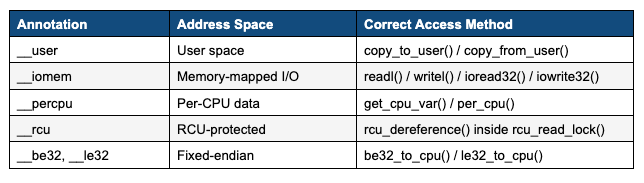
Understanding Kernel Address Spaces
The kernel defines multiple distinct address spaces, and Sparse tracks them:
Installing Sparse
On Ubuntu/Debian
sudo apt install sparse
From Source (Recommended for Latest Features)
git clone git://git.kernel.org/pub/scm/devel/sparse/sparse.git
cd sparse
make && sudo make install
Verify installation:
sparse –version
Running Sparse on Your Driver
Basic Integration with Kernel Build System
Sparse integrates with the kernel build system just like Coccinelle:
Basic Analysis
make C=1 CHECK=”sparse” M=drivers/path/to/your/driver/
Deep Analysis
make C=2 CHECK=”sparse” M=drivers/path/to/your/driver/
C=1 runs Sparse only on files that need recompilation. C=2 runs Sparse on all files in the module, even if they are up to date. Use C=2 for a comprehensive audit.
Running Sparse on a Single File
For quick iteration during development, you can run Sparse on a single file directly:
sparse -Wbitwise -Wcast-to-as -D__KERNEL__ \
-Dlinux drivers/myvendor/mydriver/mydriver.c
Note that the kernel build system integration (make C=1) handles the include paths automatically. Running sparse directly requires you to pass the right defines and include paths, which is why the make integration is usually preferable.
Understanding Sparse Warnings
Warning 1: Address Space Violation (__iomem)
This is the most common Sparse warning in driver code. It happens when you try to dereference an I/O memory pointer directly:
/* Bug: Direct dereference of __iomem pointer */
void __iomem *addr = ioremap(phys_addr, size);
u32 val = *addr; /* WRONG! */
Sparse output:
drivers/example/mydriver.c:45:28: warning: incorrect type in initializer
(different address spaces)
drivers/example/mydriver.c:45:28: expected unsigned int [usertype] val
drivers/example/mydriver.c:45:28: got void [noderef] __iomem *addr
The warning tells you exactly where the problem is and what type mismatch occurred. The [noderef] tag means you cannot dereference this pointer directly, and __iomem means it is I/O memory space.
Fix:
/* Correct: Use accessor functions */
void __iomem *addr = ioremap(phys_addr, size);
u32 val = readl(addr); /* Correct accessor */
/* Or for different sizes: */
u8 b = readb(addr); /* 8-bit read */
u16 w = readw(addr); /* 16-bit read */
u64 q = readq(addr); /* 64-bit read */
Warning 2: User Space Pointer Violation (__user)
Mixing kernel and user space pointers without the proper copy functions is a security vulnerability. Sparse catches it:
/* Bug: Direct copy from user pointer */
long my_ioctl(struct file *f, unsigned int cmd, unsigned long arg) {
struct my_data *data = (struct my_data *)arg; /* arg is __user! */
local_var = data->value; /* WARNING: Sparse flags this */
Sparse output:
drivers/mydriver/mydriver.c:87:32: warning: incorrect type in assignment
(different address spaces)
drivers/mydriver/mydriver.c:87:32: expected unsigned int [usertype]
drivers/mydriver/mydriver.c:87:32: got unsigned int [usertype] [noderef] __user *
Fix:
long my_ioctl(struct file *f, unsigned int cmd, unsigned long arg) {
struct my_data __user *udata = (struct my_data __user *)arg;
struct my_data kdata;
if (copy_from_user(&kdata, udata, sizeof(kdata)))
return -EFAULT;
local_var = kdata.value; /* Now using kernel-space copy */
Warning 3: Endianness Mismatch
This is incredibly common in hardware driver development, where you deal with device registers that have a fixed byte order different from the host:
/* Bug: Using little-endian register value as native int */
__le32 device_register; /* Register is little-endian */
u32 host_value = device_register; /* Sparse: type mismatch! */
Sparse output:
drivers/mydriver/mydriver.c:55:24: warning: incorrect type in assignment
(different base types)
drivers/mydriver/mydriver.c:55:24: expected unsigned int [usertype] host_value
drivers/mydriver/mydriver.c:55:24: got restricted __le32 [usertype] device_register
The word ‘restricted’ in the Sparse output is key. It means this type has a restricted set of operations. You cannot assign it to a plain integer without explicit conversion.
Fix:
__le32 device_register;
u32 host_value = le32_to_cpu(device_register); /* Proper conversion */
/* Or if the device is big-endian (common in network hardware): */
__be32 be_register;
u32 host_value = be32_to_cpu(be_register);
Warning 4: RCU Pointer Misuse
RCU (Read-Copy-Update) is a fundamental kernel synchronization mechanism. Sparse tracks __rcu annotations to ensure you access RCU-protected pointers correctly:
/* Bug: Accessing RCU pointer without rcu_read_lock */
struct my_device __rcu *global_dev;
void my_function(void) {
struct my_device *dev = global_dev; /* Sparse warning! */
dev->do_work();
}
Fix:
void my_function(void) {
struct my_device *dev;
rcu_read_lock();
dev = rcu_dereference(global_dev); /* Correct RCU access */
if (dev)
dev->do_work();
rcu_read_unlock();
}
Case Studies: Real Problems Sparse Solves
Case Study 1: Preventing a Security Vulnerability in Your DMA Driver
In DMA driver development, ioctl handlers are common interfaces between user space and your driver. A typical pattern looks like this:
/* Vulnerable version – before Sparse */
static long dma_ioctl(struct file *file, unsigned int cmd,
unsigned long arg) {
struct dma_transfer_params *params;
switch (cmd) {
case DMA_IOCTL_TRANSFER:
params = (struct dma_transfer_params *)arg;
/* Direct dereference of user pointer! */
start_dma(params->src_addr, params->dst_addr, params->size);
break;
}
}
Sparse immediately flags this: params is treated as a kernel pointer but arg is a __user pointer from the ioctl argument. A malicious user can pass a crafted address and read/write arbitrary kernel memory.
The fix:
/* Safe version – after Sparse feedback */
static long dma_ioctl(struct file *file, unsigned int cmd,
unsigned long arg) {
struct dma_transfer_params __user *uparams;
struct dma_transfer_params kparams;
switch (cmd) {
case DMA_IOCTL_TRANSFER:
uparams = (struct dma_transfer_params __user *)arg;
if (copy_from_user(&kparams, uparams, sizeof(kparams)))
return -EFAULT;
start_dma(kparams.src_addr, kparams.dst_addr, kparams.size);
break;
}
}
Case Study 2: MMIO Register Access in Hardware Accelerator
When you have a custom hardware accelerator with memory-mapped registers (common in EWMU/DMA controllers), the __iomem annotations are critical:
struct my_accel_dev {
void __iomem *reg_base; /* MMIO register space */
u32 *dma_buf; /* Normal kernel memory */
};
/* Bug version that Sparse catches */
void configure_dma(struct my_accel_dev *dev, u32 addr, u32 len) {
/* Wrong! Can’t use = on __iomem */
dev->reg_base[DMA_SRC_REG] = addr;
dev->reg_base[DMA_LEN_REG] = len;
}
/* Correct version */
void configure_dma(struct my_accel_dev *dev, u32 addr, u32 len) {
writel(addr, dev->reg_base + DMA_SRC_REG * 4);
writel(len, dev->reg_base + DMA_LEN_REG * 4);
}
Case Study 3: Endianness in Network/Storage Drivers
Network hardware typically uses big-endian byte order. Sparse’s __be and __le type checking prevents silent endianness bugs that only appear on little-endian hosts:
struct hw_descriptor {
__le32 src_addr; /* Hardware is little-endian */
__le32 dst_addr;
__le32 length;
__le32 control;
};
/* Bug: forgotten conversion */
void setup_descriptor(struct hw_descriptor *desc, u32 src, u32 len) {
desc->src_addr = src; /* Sparse: restricted type warning */
desc->length = len; /* Sparse: restricted type warning */
}
/* Correct */
void setup_descriptor(struct hw_descriptor *desc, u32 src, u32 len) {
desc->src_addr = cpu_to_le32(src);
desc->length = cpu_to_le32(len);
}
On a little-endian x86 system, this bug would be invisible in testing because cpu_to_le32 is a no-op. But deploy the driver on a big-endian MIPS or PowerPC system, and everything breaks. Sparse catches this at compile time regardless of host architecture.
Case Study 4: Preventing Null Pointer Crash on Error Path
Sparse performs basic null pointer tracking and can often catch cases where you dereference something that might be null:
struct clk *clk;
clk = clk_get(dev, “ahb_clk”);
/* Sparse: clk could be ERR_PTR(), should check IS_ERR() */
While Smatch is the better tool for deep null tracking (covered in Blog 3), Sparse gives you the first line of defense for type-related null issues.
Advanced Sparse Features
The context Annotation: Locking Checking
Sparse supports __acquires and __releases annotations to track locking state:
void my_lock(spinlock_t *l) __acquires(l) {
spin_lock(l);
}
void my_unlock(spinlock_t *l) __releases(l) {
spin_unlock(l);
}
/* Sparse will warn if a function acquires a lock but doesn’t release it */
void buggy_function(struct my_driver *drv) __acquires(drv->lock) {
spin_lock(&drv->lock);
if (error_condition)
return; /* Sparse: lock not released on this path! */
spin_unlock(&drv->lock);
}
Context Annotations for Your Own APIs
If your driver has its own locking wrappers (common in multi-application driver scenarios), you can annotate them:
/* Annotate your driver’s lock wrappers */
static inline void drv_lock(struct my_drv *d)
__acquires(d->hw_lock)
{
spin_lock_irqsave(&d->hw_lock, d->flags);
}
static inline void drv_unlock(struct my_drv *d)
__releases(d->hw_lock)
{
spin_unlock_irqrestore(&d->hw_lock, d->flags);
}
Integrating Sparse Into Your Workflow
Make Sparse Part of Every Build
Unlike Coccinelle, Sparse is fast enough to run on every build. Add it to your Makefile:
# In your module’s Makefile or build script
sparse:
$(MAKE) C=2 CHECK=”sparse” M=$(DRIVER_DIR)/ \
-C $(KERNEL_DIR)
.PHONY: sparse
Jenkins CI Stage for Sparse
stage(‘Static Analysis – Sparse’) {
steps {
sh ”’
make C=2 CHECK=”sparse” M=drivers/myvendor/mydriver/ \
2>&1 | tee sparse_report.txt
# Fail build if any warnings found
grep -c “warning” sparse_report.txt && exit 1 || exit 0
”’
archiveArtifacts ‘sparse_report.txt’
}
}
Pre-Commit Hook for Sparse
#!/bin/bash
# .git/hooks/pre-commit
echo “Running Sparse type checking…”
WARNINGS=$(make C=2 CHECK=”sparse” M=drivers/myvendor/mydriver/ 2>&1 | grep -c warning)
if [ “$WARNINGS” -gt 0 ]; then
echo “Sparse found $WARNINGS warnings. Fix them before committing.”
make C=2 CHECK=”sparse” M=drivers/myvendor/mydriver/ 2>&1 | grep warning
exit 1
fi
echo “Sparse: no warnings!”
Common Issues Quick Reference
Issue: __iomem Dereference
Problem: Directly dereferencing __iomem pointers instead of using accessor functions.
*addr = value; // Sparse error: address space violation
Fix:
writel(value, addr);
Issue: Missing __user Annotation on ioctl Argument
struct my_data *data = (struct my_data *)arg; // Wrong!
data->field = result; // Sparse: writing to user pointer
Fix:
struct my_data __user *udata = (struct my_data __user *)arg;
put_user(result, &udata->field);
Issue: Endianness in DMA Descriptors
desc->length = transfer_size; // Sparse: restricted __le32
Fix:
desc->length = cpu_to_le32(transfer_size);
Performance Considerations
Sparse adds roughly 10-20% to compilation time, making it practical to run on every build. This is unlike Coccinelle, which can be 50-100% slower and Smatch which needs a heavyweight database.
- Run Sparse on every build using C=1 during active development
- Use C=2 for comprehensive checks before patch submission
- Treat Sparse warnings as errors in your CI pipeline
- Zero Sparse warnings should be a hard gate for merging code
Summary and What’s Next
Sparse is your first and fastest line of defense in driver type safety. It should be a non-negotiable part of every build. Key takeaways:
- Always use __user, __iomem, and other annotations in your driver code
- Treat every Sparse warning as a potential security vulnerability or crash
- Use readl/writel accessors for all MMIO register access, never direct dereferences
- Always use copy_from_user/copy_to_user when dealing with ioctl arguments
- Use cpu_to_le32/be32_to_cpu for all device descriptor endianness conversions
- Add Sparse to your CI pipeline and treat warnings as build failures
Up Next: Blog 3 of 3
Smatch — The Deep Analyzer
Sparse caught the type errors. Now Smatch goes deeper: path-sensitive analysis,
variable range tracking, cross-function null pointer analysis, deadlock detection,
and resource leak detection. If Sparse is your X-ray, Smatch is your MRI.
Additional Resources
- Linux Kernel Documentation on Sparse: https://sparse.docs.kernel.org/
- Kernel annotations reference: include/linux/compiler_types.h
- Linux Kernel Coding Style Guide: https://www.kernel.org/doc/html/latest/process/coding-style.html
- Kernel Newbies Static Analysis: https://kernelnewbies.org/StaticAnalysis
Happy coding, and may your drivers always be bug-free!