Understanding OSC XML: From Fundamental Structure to Advanced Scenario Modeling 


Introduction

OpenSCENARIO (OSC) is an industry-standard format used to describe the dynamic elements of driving simulation scenarios. The standard consists of two major components: OpenSCENARIO DSL, a domain-specific language intended for high-level scenario authoring, and OpenSCENARIO XML, a structured XML-based format for defining detailed, tool-independent simulation scenarios. While the DSL aims to make scenario creation more intuitive for users, the XML format provides the underlying structure used by simulators to interpret maneuvers, events, triggers, and the conditions governing vehicle behavior.

Scenario-based testing has become essential in autonomous vehicle (AV) development, as AV systems must demonstrate safe performance across a wide range of realistic and repeatable traffic conditions. The OSC XML standard supports this requirement by offering a consistent and scalable way to model these scenarios across different simulation and validation platforms.

In this blog, the focus will be on the OSC XML standard, explaining its structure, core components, and practical usage. I will begin with the basic building blocks of the XML format and then explore how maneuvers, triggers, and events work together in a simple example scenario. The goal is to provide a clear and structured introduction for anyone starting their journey with OSC XML.


Role In Development

OSC XML plays a vital role in autonomous vehicle development by allowing engineers to define vehicle behaviors, environmental conditions, and interactions with other road users in a structured, standardized format. This enables systematic testing of algorithms and software components, helping identify potential issues early in the design cycle and reducing costly development iterations. For OEMs, OSC XML provides a way to validate vehicle performance without relying solely on physical testing, ensuring that vehicles meet safety standards and regulatory requirements consistently while facilitating collaboration across teams and suppliers. Additionally, in verification and validation (V&V) processes, OSC XML supports automated, repeatable testing, allowing engineers to cover complex traffic situations and edge cases that are difficult to replicate in real-world conditions. By improving test coverage and confidence in vehicle behavior, OSC XML ultimately enhances the safety, reliability, and efficiency of autonomous vehicle development.


Basics of OSC XML

OSC XML is built on a structured XML schema that defines how scenarios are organized and executed within a simulation environment. Each OSC XML file follows a hierarchical model, ensuring clarity and predictability in how simulation events unfold. Understanding this structure is the first step toward creating robust and reusable scenarios for autonomous vehicle (AV) testing.

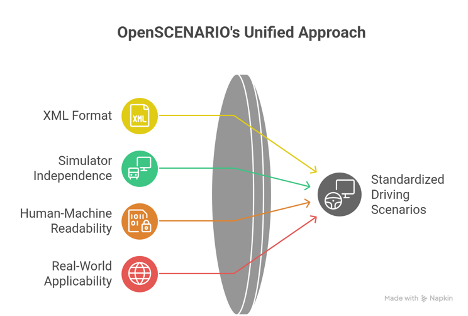
OpenScenario's Unified Approach

This illustration highlights how OpenSCENARIO provides a unified and standardized approach to defining driving scenarios. By leveraging an XML-based format, ensuring simulator independence, and maintaining human-readable structure, OSC XML enables consistent scenario creation across tools and platforms. Its real-world applicability makes it a reliable foundation for testing and validating autonomous driving systems.

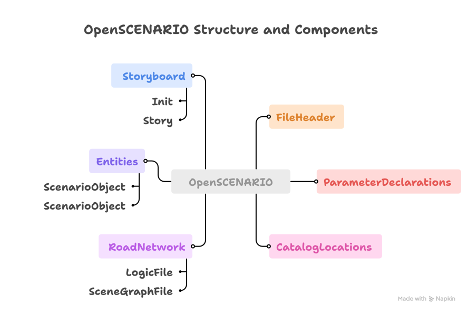
OpenScenario Structure and Component
  1. File Header – Contains metadata like version and description to ensure proper documentation and traceability.
  2. Catalogs – Stores reusable elements such as vehicles, controllers, and maneuvers for consistent scenario creation.
  3. Road Network – Links to the road model (e.g., OpenDRIVE) that defines the environment in which the scenario runs.
  4. Entities – Defines all participating actors, including the Ego vehicle and other traffic participants.
  5. Storyboard – Describes the scenario flow through initialization, actions, maneuvers, events, and triggers.
  6. This hierarchical organization ensures that scenario logic flows clearly from initialization to execution.

Maneuvers, Events, and Triggers in OSC XML

The behavioral logic of any OpenSCENARIO file is defined through a structured combination of maneuvers, events, and triggers. These elements determine what an entity does, when it does it, and under which conditions the scenario progresses. Understanding how they interact is essential for designing meaningful and realistic simulation scenarios.

Maneuvers – Define high-level behaviors for an entity, such as accelerating, stopping, or changing lanes.

Events – Represent specific actions within a maneuver, activated or stopped based on conditions.

Triggers – Specify the conditions that start or stop an event, controlling the scenario flow.


Conclusion:

OpenSCENARIO (OSC XML) plays a pivotal role in autonomous vehicle simulation by providing a standardized, structured, and simulator-independent framework for defining dynamic driving scenarios. Its XML-based hierarchy enables precise modeling of entities, maneuvers, events, and triggers, allowing scenario designers to create realistic and repeatable interactions essential for evaluating perception, planning, and control systems. As simulation-driven validation becomes increasingly important, OSC XML’s flexibility and extensibility support a wide range of testing needs from simple behaviors to complex, multi-actor situations—helping teams accelerate development, improve scenario coverage, and build confidence in system performance before real-world deployment.
 

Coming Soon…

In the next blog in this series, I will explore how OSC XML can be used to construct more advanced and high-interaction scenarios. This will include complex junction cases, pedestrian involvement, and multi-vehicle behaviors such as cut-in, cut-out, and overtaking maneuvers. These examples will illustrate how OSC XML enables the creation of rich and realistic testing conditions that challenge autonomous systems at a deeper level. Stay tuned!
100% LikesVS
0% Dislikes

Author