1. Introduction
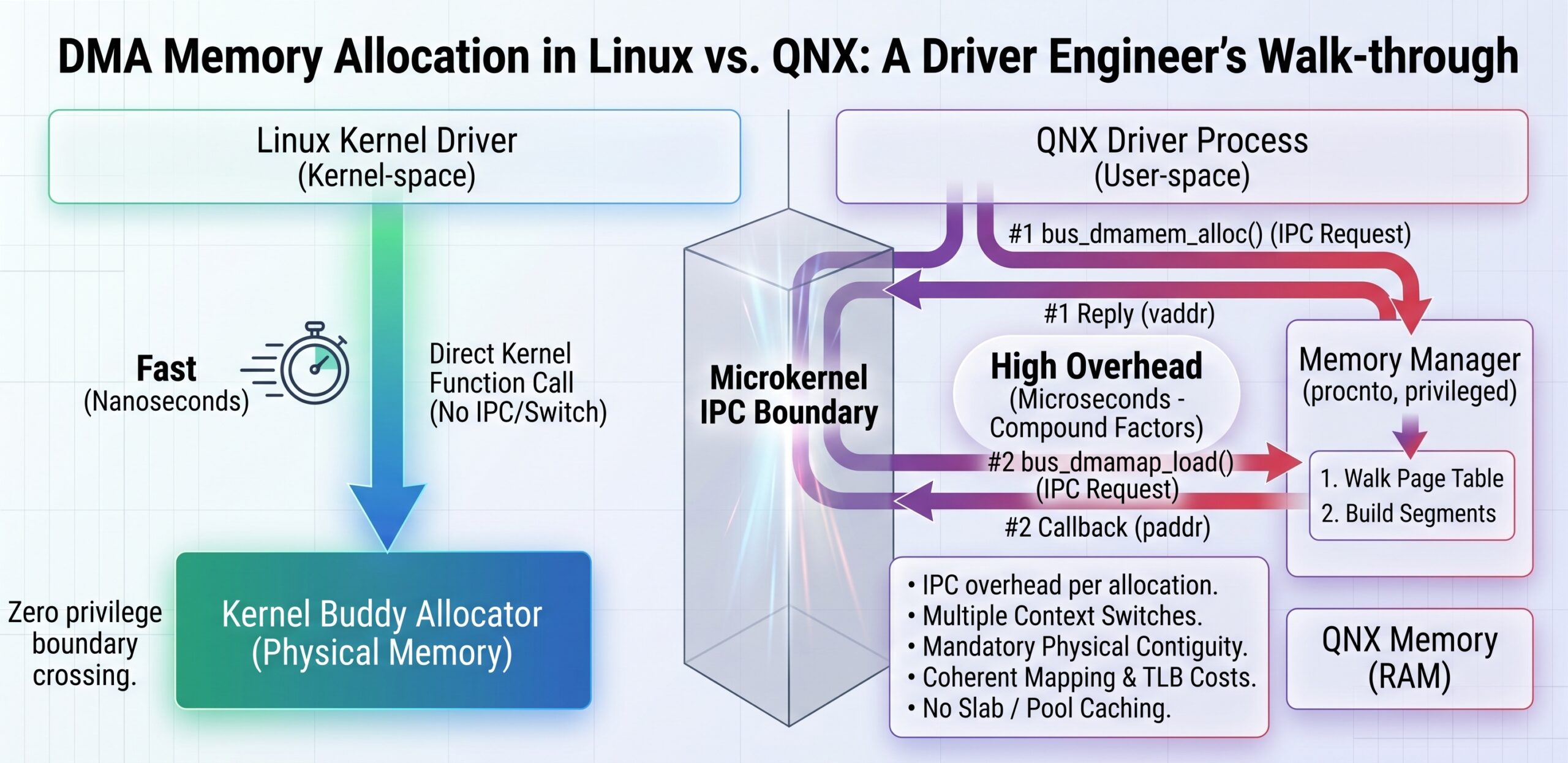
If you have spent time writing device drivers on Linux, page allocation probably does not feel expensive. You call alloc_pages_node(), get your memory back in nanoseconds, and move on. The buddy allocator lives inside the kernel and resolves your request without crossing any privilege boundary.
Switch to QNX and the picture changes completely. QNX is a microkernel OS — drivers run as ordinary user-space processes, and the memory manager (procnto) is a separate privileged process. Every time your driver needs physical memory for DMA, it must send an IPC message across the microkernel boundary to procnto, wait for it to find and lock pages, and receive the mapping back. What took nanoseconds in Linux now takes microseconds in QNX.
This blog unpacks exactly why that cost exists, how the Linux order-based fallback compares to QNX’s DMA tag packing strategy, and — crucially — how QNX driver engineers design around the overhead. We will use real RX path code from both an Ethernet driver ported to Linux and the same driver on QNX to make every comparison concrete.

2. How Linux Allocates Pages — The Buddy Allocator and Order-Based Fallback
2.1 The Buddy Allocator in One Paragraph
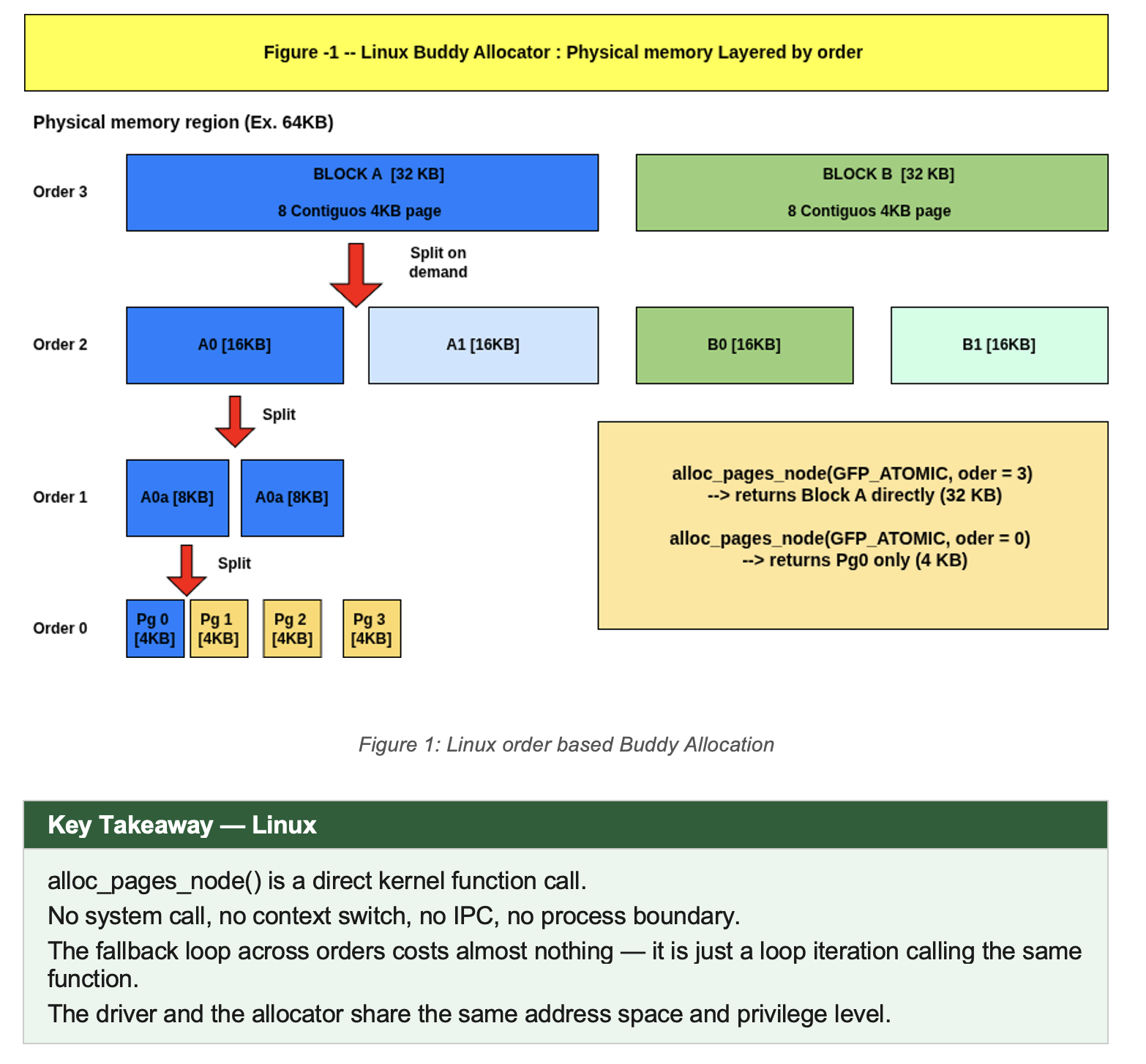
Linux manages physical memory through the buddy allocator. Memory is tracked in power-of-two-sized blocks called orders: order-0 is one page (4 KB), order-1 is two contiguous pages (8 KB), order-3 is eight contiguous pages (32 KB). The buddy allocator lives entirely inside the kernel. When your driver calls alloc_pages_node(), that resolves to a bitmap lookup in the kernel’s free_area[ ] array — no system call, no context switch, no IPC, and no privilege boundary crossing whatsoever.
2.2 Order-Based Fallback — Graceful Degradation for Free
A key design feature of the Linux buddy allocator is graceful degradation under memory pressure. When a higher-order allocation fails — because the physical address space is fragmented and no large contiguous block is available — the driver can retry at lower orders in a simple loop. Here is the actual pattern from an Ethernet driver’s RX buffer allocation.
3. How QNX Allocates DMA Memory — The Microkernel IPC Tax
3.1 The Microkernel Changes the Rules
QNX Neutrino is a true microkernel OS. The kernel itself is tiny — it handles thread scheduling, IPC, and interrupt dispatch. Everything else, including the memory manager, the filesystem, and all device drivers, runs as separate user-space processes communicating via message passing.
This architecture gives QNX exceptional fault isolation. A crashed Ethernet driver cannot corrupt the kernel or other drivers — it is just a dead user-space process that can be restarted. But it comes with a fundamental cost: any time your driver needs a kernel service, including physical memory allocation, it must send an IPC message across the microkernel boundary to the memory manager process (procnto) and wait for a reply.
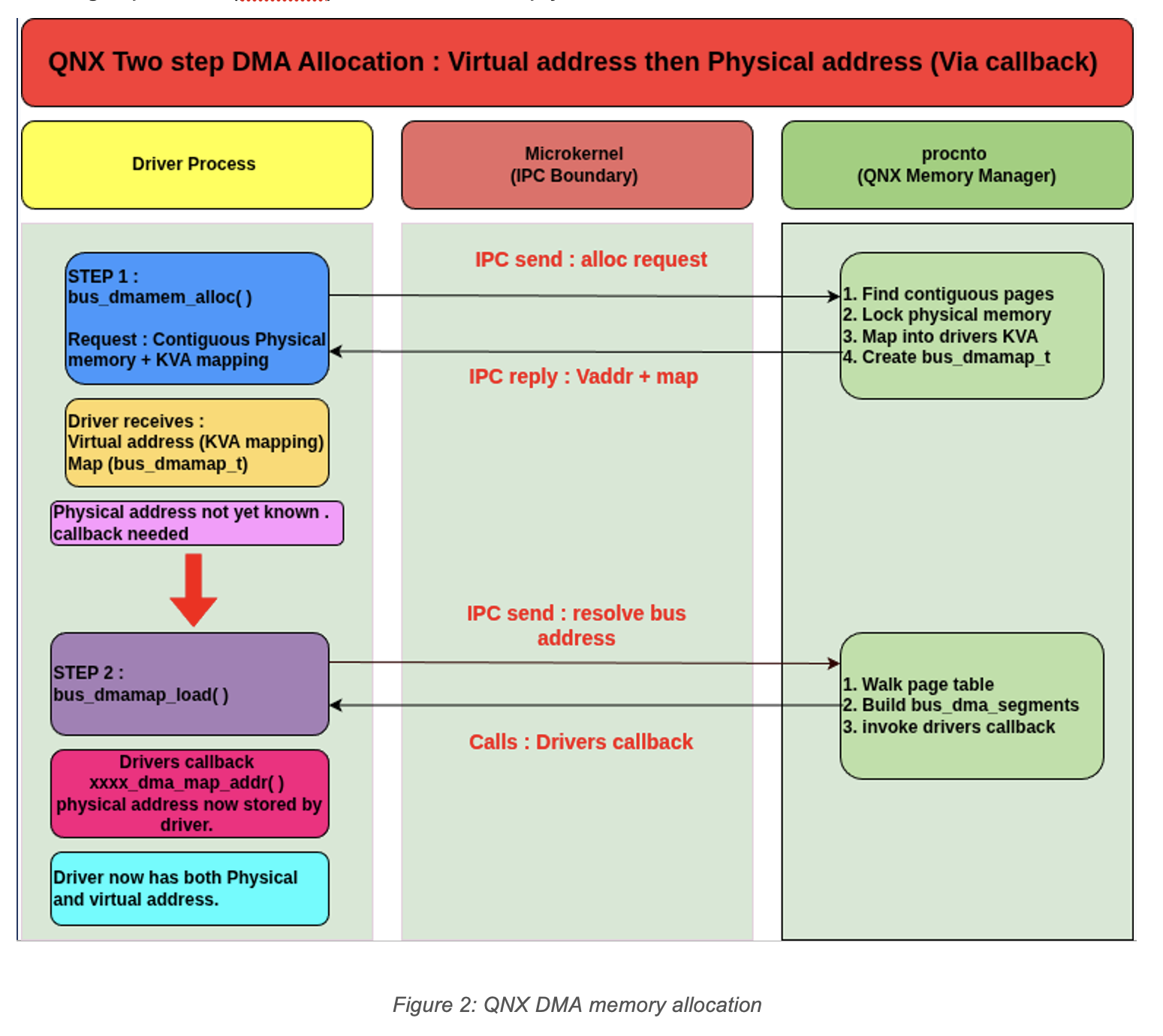
The memory manager — procnto — is a separate privileged process. They communicate through the microkernel via IPC. Obtaining a single DMA buffer requires two separate round-trips:
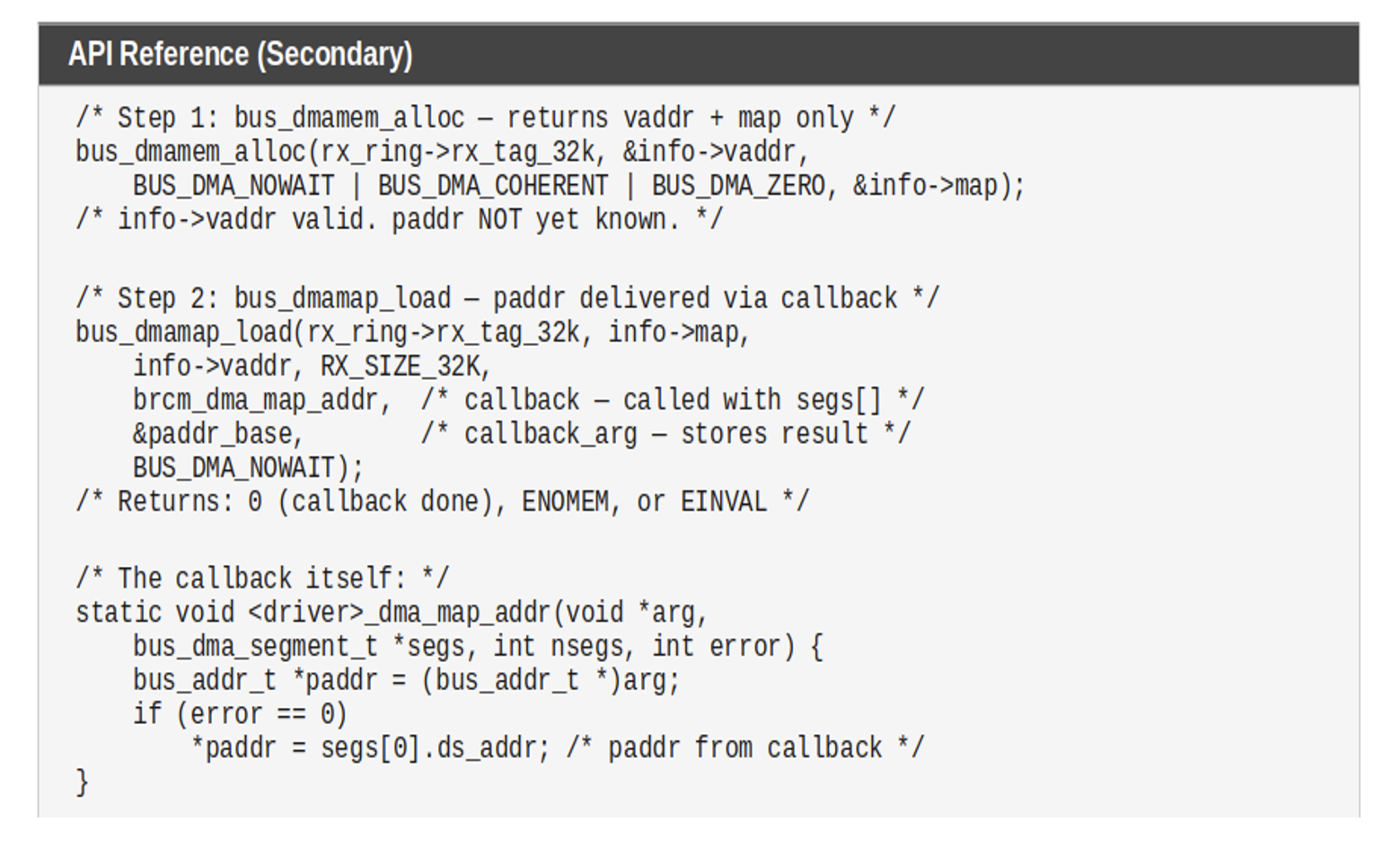
- bus_dmamem_alloc() — asks procnto to allocate a physically contiguous region and map it into the driver’s virtual address space. Returns vaddr only. Physical address is not yet known.
- bus_dmamap_load() — asks procnto to resolve the bus address for that region. Physical address (paddr) is delivered via a callback — not as a return value.
The driver cannot skip Step 2 or compute paddr from vaddr itself. QNX virtual address space does not expose the page table to the driver process — only procnto can walk it. This is by design: process isolation means the driver cannot see physical memory directly.
3.2 DMA Tags — The QNX Equivalent of GFP Flags + Order
In Linux, you express allocation constraints through gfp_t flags and an order integer. In QNX, the equivalent mechanism is a DMA tag (bus_dma_tag_t). A tag encodes alignment requirements, physical address constraints, maximum allocation size, and contiguity guarantees — all declared upfront before any allocation happens.
Creating a tag with bus_dma_tag_create() is relatively inexpensive. The costly operation is bus_dmamem_alloc() — which fires the IPC call to procnto to actually obtain physical pages — followed by bus_dmamap_load() to retrieve the bus (DMA) address.
4. The Cost Comparison — Exactly Where QNX Is Slower: Five compounding reasons
4.1 Where the Cost Lives
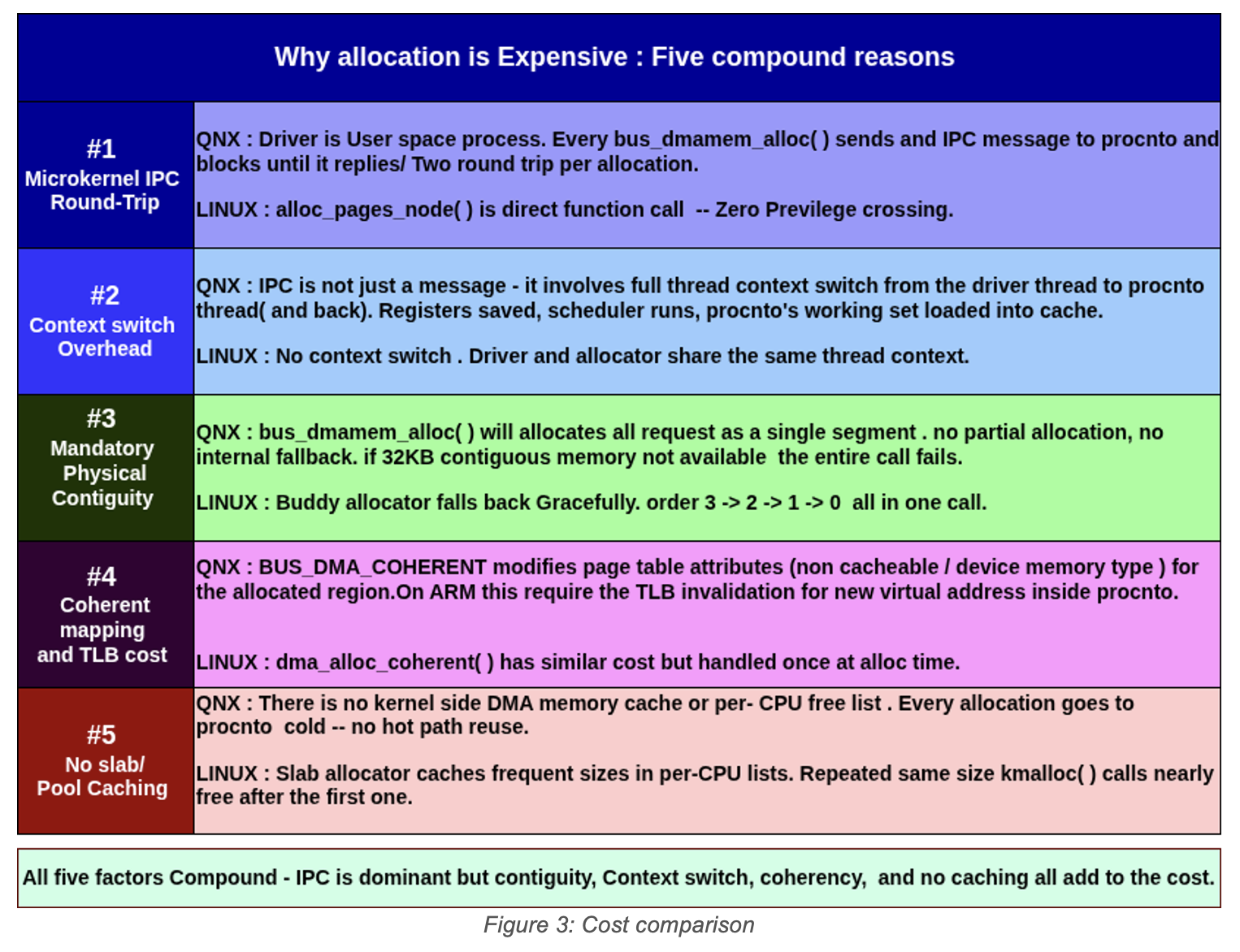
- Microkernel IPC round-trip : two crossings per alloc (~1–50 µs each). Dominant cost.
- Full thread context switch : driver thread ↔ procnto thread, registers saved, cache cold.
- Mandatory physical contiguity : “allocated as a single segment.” No fallback inside the call.
- Coherent mapping + TLB flush : BUS_DMA_COHERENT sets non-cacheable page attributes on ARM.
- No slab / pool caching : every call goes to procnto cold. Linux slab makes repeat allocs free.
Reasons 1 and 5 are directly mitigated by the 32 KB packing strategy (Section 5).
Reasons 2, 3, and 4 are architectural — they apply to every allocation and can only be amortized.
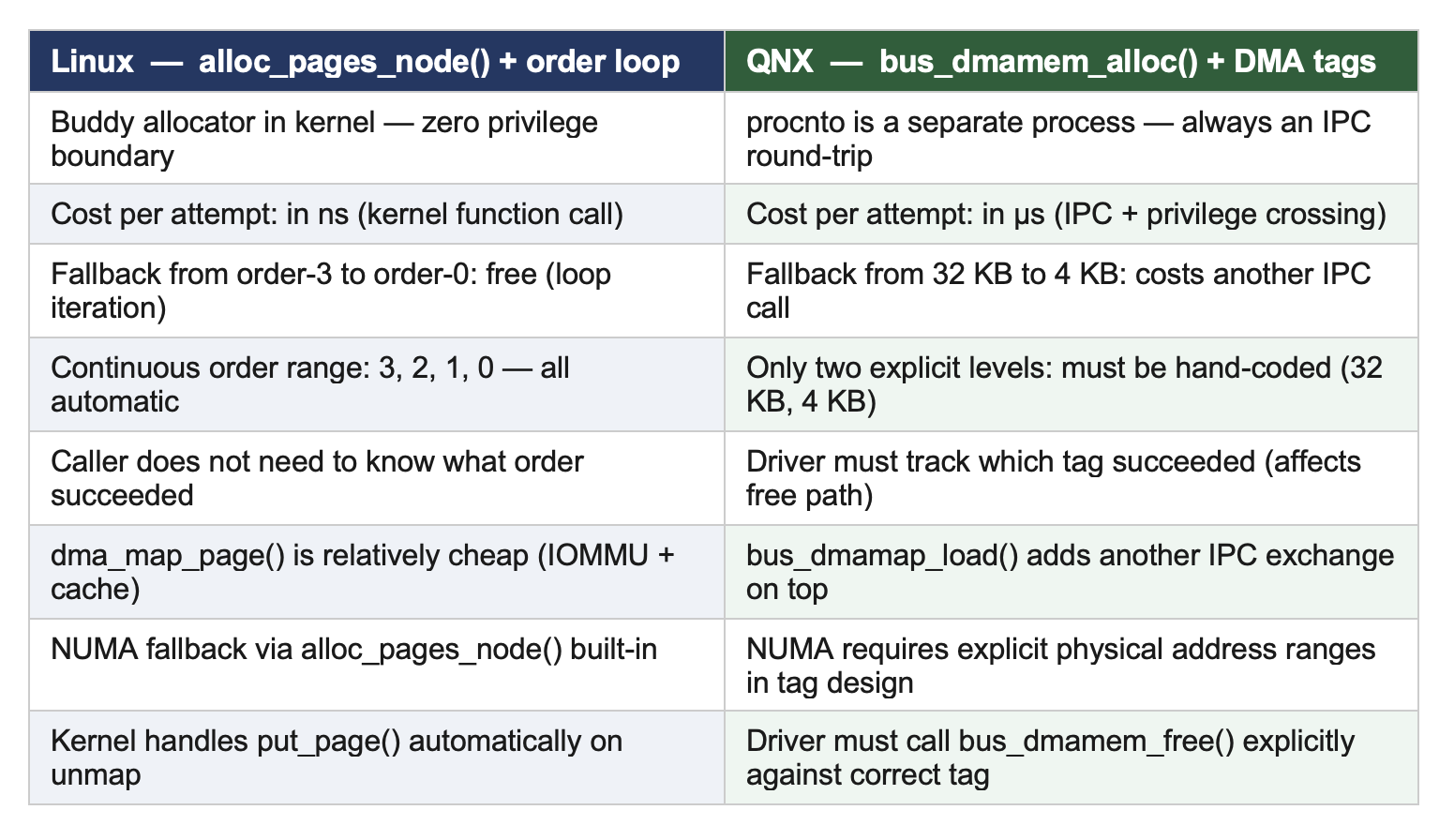
4.2 Side-by-Side: Fallback Mechanism Compared
5. Design Principles for QNX Driver Engineers
5.1 Maximize Block Size to Minimize IPC Call Count
The single most important rule: request the largest physically contiguous block you can get in one IPC call, then slice it yourself. With a 256-descriptor ring and 2 KB per slot:
- 32 KB blocks: 16 slots per block → 16 IPC calls at ring init
- 4 KB blocks: 2 slots per block → 128 IPC calls at ring init
- 2 KB blocks: 1 slot per block → 256 IPC calls at ring init (worst case)
Preferring 32 KB blocks reduces IPC calls at initialization by 16x. The same saving applies at teardown — 16 bus_dmamem_free( ) calls instead of 256.
6. Closing Thoughts
The cost gap between Linux and QNX page allocation is not a defect in QNX — it is an architectural trade-off. QNX pays a per-allocation IPC cost in exchange for the microkernel’s fault isolation guarantee: a driver that crashes or corrupts its own memory cannot take down the kernel or any other driver. For automotive, medical, and safety-critical systems, that guarantee is worth the engineering complexity.
But the complexity is real. QNX driver engineers must think about memory allocation strategy at design time in a way that Linux engineers rarely have to. The patterns that emerge — large block pre-allocation at init, ref-counted shared buffers, explicit tag-per-size discipline, and zero dynamic allocation in the hot path — are not workarounds. They are idiomatic QNX driver design.
If you are coming from Linux kernel driver development and moving to QNX, internalizing this one difference early will save you from subtle performance bugs and hard-to-diagnose latency spikes. Allocate large. Allocate early. Track your tags. And never, ever allocate in your interrupt path.