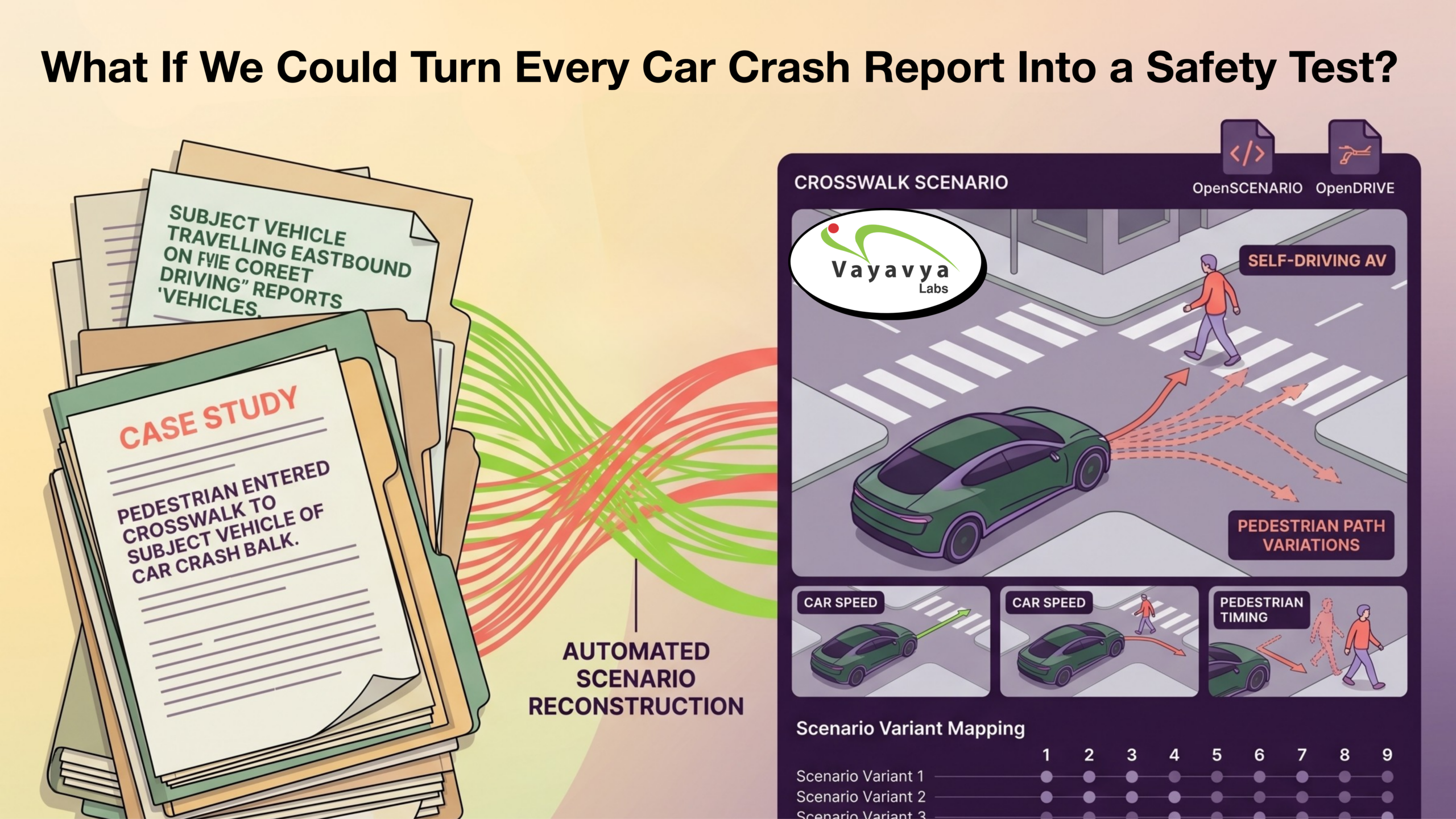
Every year, police officers and crash investigators file millions of accident reports. They describe what happened in plain language: who was involved, what the road looked like, and how the collision unfolded. These reports pile up in national databases, cataloguing decades of knowledge about the ways vehicles, pedestrians, and cyclists can come into conflict.
There’s just one problem: engineers building the self-driving cars of tomorrow can’t easily use any of it.
Modern ADAS (Advanced Driver Assistance Systems) and autonomous vehicle software are tested extensively in simulation, in virtual environments where engineers can run a car through dangerous situations without putting anyone at risk. But simulation scenarios are quantitatively precise: exact speeds, GPS coordinates, and other time series data. Accident reports give you sentences. The two do not speak the same language.
Reconstruction, Not Replay
A new technical approach developed by Vayavya Labs addresses this directly. Rather than trying to replay an accident (impossible without detailed quantitative time-series data that does not exist in accident reports), the tool reconstructs it. Feed in a written crash report; get back a set of physically plausible simulation scenarios that capture how the accident could have played out.
Think of it this way: a crash test conducted at 55 km/h tells you something genuinely useful, even if most real-world impacts don’t happen precisely at 55 km/h. A reconstructed accident scenario works on the same principle. It doesn’t claim to be a perfect copy of history. It claims to be a physically valid, outcome-anchored test case that exercises your system against a real-world risk pattern.
More Useful Than a Single Recording
Here’s a counterintuitive insight from the whitepaper: reconstruction can actually be more valuable than replaying a recorded trace, even when a recording exists. A single recorded log shows you one path through a dangerous moment, and it may be the easiest version: the pedestrian hesitated a half-second longer than they might have, or the oncoming vehicle was going just slowly enough. Reconstruction generates multiple plausible versions of the same accident, testing your system against the range of ways it could have unfolded. If your car handles all of them, that’s a much stronger safety claim.
The approach also aligns with ISO 21448 (SOTIF) and ISO 34502, which require testing against broad scenario families rather than specific data points. And it has regulatory implications: governments around the world are moving toward requiring demonstrated scenario coverage for self-driving approval. Companies that haven’t tested against the documented accident history of their deployment areas will face hard questions from regulators.
Dark Data, Brought to Light
Decades of accident reports represent a largely unused resource. They are especially rich in scenarios involving pedestrians and cyclists, the situations where the cost of failure is highest and where traditional highway-focused test data is thinnest. Automated reconstruction can convert these reports into simulation-ready test suites at a fraction of the cost of manual scenario authoring, and at a scale no team of human experts could match.
Vayavya Labs has ingested multiple accident databases and consolidated the harvested simulation scenarios in a readily available database. The generated scenarios are in industry-standard formats (OpenSCENARIO and OpenDRIVE), compatible with established simulation toolchains. Each scenario can then serve as a seed for further automated variation, producing thousands of kinematic variants that map the performance boundaries of a system under test.
Want to Read in Detail?
The full technical whitepaper, From Narrative to Simulation: Bridging the Gap Between Qualitative Accident Reports and Quantitative ADAS/AD Validation, covers the methodology in detail: the value of reconstruction, a head-to-head comparison against alternative validation approaches, and the road ahead for validating the technique itself.
Read the full whitepaper here: https://vayavyalabs.com/whitepapers/scenario-reconstruction-for-adas-ad-validation/